How Do Nasal Strips Work? The Evidence, Explained (2026)
An ENT explains how nasal strips work mechanically and what the published research actually shows about snoring, breathing, athletic performance, and sleep apnoea.



Most articles about nasal strips answer the question "do they work?" with either an enthusiastic yes or a dismissive no. Both answers are oversimplified. The accurate picture is that nasal strips do something specific and measurable, and whether that specific something solves your specific problem depends on what your problem actually is.
This article explains the mechanism of action in clinical terms, walks through the published evidence for each main use case (nasal airflow, snoring, athletic performance, and obstructive sleep apnoea), and lays out the patient features that predict whether a strip is likely to help. For a broader overview of nasal strips as a category, see the complete clinical guide to nasal strips.
Key takeaways
- Nasal strips work by exerting outward tension on the bridge of the nose, mechanically widening the nasal valve, the narrowest segment of the entire upper airway.
- The effect on nasal airflow is well established and consistent across studies. The effect on symptoms such as snoring, sleep quality, and athletic performance is real but smaller and more variable.
- The evidence is strongest for nasal airflow improvement, modest for mild primary snoring, mixed for athletic performance, and consistently negative for obstructive sleep apnoea.
- Patients respond differently because the underlying cause of their symptom may or may not involve the nasal valve. The Cottle manoeuvre is a simple bedside test that predicts response.
- A one-week trial of a correctly applied strip is the most reliable way to assess whether a strip will help in any individual case.
The mechanism in plain terms
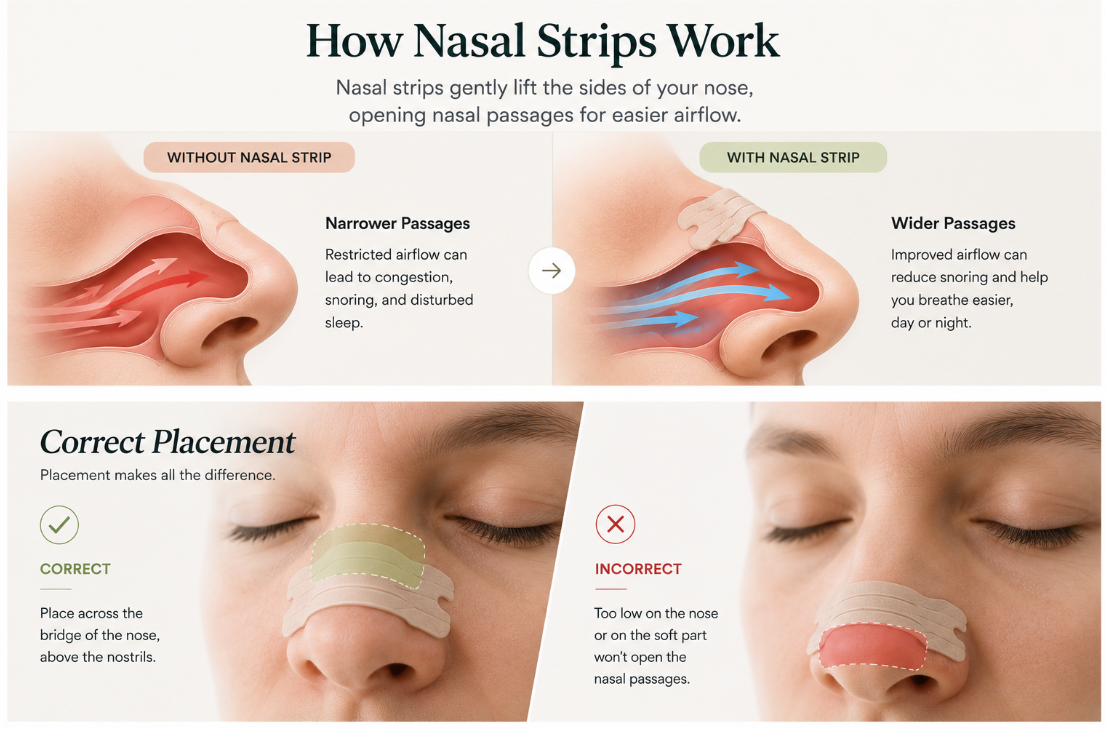
A nasal strip is a flexible adhesive band worn across the bridge of the nose. Inside the strip is a springy plastic spline, sandwiched between layers of fabric or polymer film. When the strip is flattened against the skin and the adhesive bonds, the plastic continues to try to return to its original curved shape. That stored mechanical tension pulls outward on the lateral walls of the nose.
This outward pull is small in absolute terms, of the order of a few millimetres of lateral displacement, but it acts on a region where small changes in cross-sectional area translate into measurable changes in airflow. The reason this matters is the unusual anatomy of the nasal valve, which the next section explains.
The nasal valve: why this one region matters so much
The nasal valve is the narrowest segment of the entire airway, from the nostrils to the lungs. It sits approximately one centimetre inside the nostril, where the upper lateral cartilage of the nose meets the wall of the nasal septum. In cross-section, the valve is shaped like a thin slit, only a few millimetres wide. Despite occupying a tiny portion of the airway by length, the nasal valve is responsible for more than half of the total resistance to airflow through the nose [1].
This anatomical fact has two consequences. The first is that any narrowing at the nasal valve has an outsized effect on how hard a person has to breathe to move a given volume of air. A patient whose nasal valve is partially narrowed, whether from mucosal swelling, dynamic collapse during inspiration, or anatomical variation, is doing more inspiratory work than they realise. The second consequence is that small mechanical changes at this region produce relatively large changes in airflow.
This is the precise leverage a nasal strip uses. By pulling outward on the lateral nasal walls, the strip increases the minimum cross-sectional area of the valve by a small amount, and this small change reduces nasal airway resistance measurably. Acoustic rhinometry and rhinomanometry studies have demonstrated this effect repeatedly across the published literature [2].
The clinically important implication is that strips can only act on the nasal valve. If the patient's symptom originates further down the airway, in the pharynx for example, the strip's mechanism cannot reach the problem.
What the published evidence actually shows
This is the section most patients want and most articles skip past. The evidence for nasal strips is real but uneven across the conditions for which they are marketed.
Effect on nasal airflow
The strongest evidence supports the basic mechanical claim. Studies using acoustic rhinometry consistently show that wearing a nasal strip increases the minimum cross-sectional area of the nasal valve. Studies using rhinomanometry consistently show that nasal airway resistance falls when a strip is in place [1] [2]. These findings are robust across multiple investigator groups, multiple strip brands, and a range of patient populations. There is essentially no controversy on this point. Nasal strips do what they are physically designed to do.
What is more variable is how much the patient subjectively notices the change. Patients with significant baseline nasal valve narrowing usually report a clear sense of easier breathing. Patients with already-patent nasal valves may notice little or no change, because there is little obstruction to relieve.
Effect on mild snoring
The evidence for snoring is real but considerably more modest than the airflow data, and effect sizes vary widely between studies.
The earliest meaningful clinical work was by Ulfberg and Fenton in 1997, who reported bed-partner-observed reductions in snoring intensity with Breathe Right strips in patients with primary snoring [3]. A separate 1998 trial in primary snorers found measurable reductions in both snoring duration and snoring loudness for a majority of participants, although the magnitude of the response varied significantly between individuals.
More recent trials, including a 2019 examination of nasal dilator strips in patients with sleep-disordered breathing, found that strips produced variable improvements in subjective sleep quality and snoring outcomes. The strongest responses occurred in patients whose primary site of obstruction was clearly at the nasal valve [4]. Patients whose snoring originated further back in the airway, at the soft palate or base of the tongue, generally showed little response.
Several smaller studies have been unable to distinguish the strip's effect from placebo. A 2019 study in patients with chronic nasal congestion found that strips did not significantly improve sleep quality or congestion compared with a placebo strip that did not exert outward tension. This is an important finding and is discussed further in the placebo section below.
The clinical interpretation, supported across the literature, is that strips can produce a modest reduction in mild primary snoring in patients whose snoring originates at the nasal valve, with no expectation of effect in patients with predominantly pharyngeal-origin snoring. For a fuller treatment of strips specifically as a snoring intervention, including how to identify which patients are most likely to respond, see the dedicated article on nasal strips for snoring.
Effect on athletic performance
Strips were originally marketed for athletic use. The published evidence on whether they actually improve athletic performance is mixed.
Several studies have measured perceived effort and respiratory comfort during exercise, and these subjective measures tend to favour strip use. Athletes report that nasal breathing feels easier at moderate to high intensities when wearing a strip, and they often delay the transition from nasal to mouth breathing.
Objective performance measures tell a less consistent story. Studies measuring maximal oxygen uptake (VO2 max), time-to-exhaustion, lactate threshold, and other physiological markers have generally found no statistically significant differences with versus without a strip [5]. The most defensible conclusion is that strips may improve the subjective experience of breathing during exercise without measurably changing performance outcomes. Whether this perceived improvement is clinically valuable depends on the individual.
Effect on obstructive sleep apnoea
This is the use case where the evidence is consistently negative, and it is also the most clinically important.
Obstructive sleep apnoea (OSA) is characterised by repeated partial or complete collapse of the upper airway during sleep, typically at the level of the soft palate or the base of the tongue. The site of obstruction in OSA is well downstream of the nasal valve. Widening the nostrils does not prevent the throat from collapsing.
Systematic reviews and clinical practice guidelines from the American Academy of Sleep Medicine identify continuous positive airway pressure (CPAP) as the first-line therapy for moderate to severe OSA, with oral appliances, positional therapy, and surgery for selected patients [6]. External nasal dilators are not listed as a therapeutic option for OSA.
A small role exists for nasal strips as an adjunct to CPAP therapy in some patients. By lowering nasal resistance, a strip can improve CPAP mask comfort and may modestly reduce the required treatment pressure. This adjunctive role does not change the underlying conclusion that nasal strips do not treat OSA themselves.
Why patients respond so differently
Looking across the literature and clinical experience, the most important predictor of whether a given patient will respond to a nasal strip is the anatomical origin of their symptom.
In patients with clear nasal valve narrowing, whether from mucosal swelling (allergic rhinitis, post-viral congestion, climate-related dryness), from dynamic collapse of the outer nostril wall during inspiration, or from mild congenital variation, strips produce a clinically meaningful improvement in nasal airflow that often translates into perceived symptom relief. In patients without nasal valve narrowing, the strip still produces its mechanical effect on the valve, but because the valve was not the bottleneck to begin with, no symptomatic benefit follows.
A few additional patient features influence response:
- Body mass index. Patients with significant obesity often have multiple sites of airway compromise, including pharyngeal narrowing, and isolated nasal interventions are less likely to help.
- Sleeping position. Pharyngeal snoring is markedly worse in the supine position. Strips do not modify that pattern.
- Alcohol and sedative use. Both relax the muscles of the upper airway and worsen pharyngeal collapse, neither of which is addressed by a nasal strip.
- Time-of-day variation in nasal congestion. Patients whose congestion is worse at night, often because of allergic rhinitis or supine venous pooling in the nasal mucosa, are good candidates for night-time strip use.
The placebo question, addressed honestly
Several well-designed trials have included a placebo strip, designed to look identical to a real strip but without the outward spring tension. This design lets researchers separate the mechanical effect of the strip from the psychological effect of wearing something on the nose.
In trials of subjective measures such as perceived sleep quality and self-reported congestion, the placebo strip often produces a meaningful response, sometimes nearly as large as the real strip. This is not a problem unique to nasal strips. It is a well-known feature of interventions for sleep and breathing symptoms, where the act of doing something is itself partially therapeutic.
What survives placebo control is the airflow effect. Objective measures, including acoustic rhinometry and nasal resistance, consistently distinguish the real strip from placebo. The mechanical effect is real and not attributable to expectation.
In clinical practice, this means a patient may notice an apparent benefit from a nasal strip even if their underlying obstruction is not at the nasal valve. This is not nothing. Improved subjective sleep quality is a legitimate outcome. But it does mean that the right way to judge a strip's effectiveness in an individual case is not solely by how the patient feels in the first night. A more reliable assessment uses objective markers, such as bed-partner observation of snoring, combined with at least a week of consistent correct use.
How to predict whether a strip will help you
The most useful bedside test for nasal valve dysfunction is the Cottle manoeuvre. The patient looks in a mirror and gently pulls the cheek laterally near the side of the nose, away from the centreline, while breathing in through the nose. If nasal airflow feels noticeably easier with this manoeuvre, the nasal valve is likely contributing to the obstruction, and a nasal strip is reasonable to trial. If the manoeuvre produces no perceived improvement, the obstruction is likely further inside the nose or in the pharynx, and a strip is unlikely to help.
A few other practical predictors of response include:
- Nasal symptoms that are clearly worse at night or when lying down
- A sense of one nostril being more affected than the other
- Snoring that is mild and not associated with daytime sleepiness or witnessed apnoeas
- A clear pattern of allergic rhinitis with nasal congestion as a dominant symptom
Patients with multiple positive predictors and no red-flag features are good candidates for a one-week trial. Patients with red-flag features, particularly witnessed pauses in breathing, choking arousals, or unrefreshing sleep, should be evaluated for obstructive sleep apnoea before relying on over-the-counter devices.
Common misconceptions about how strips work
Several persistent misconceptions appear in patient education material online. Brief corrections are useful.
"Nasal strips reach into your sinuses." They do not. The strip acts only on the outer cartilaginous and skin-overlying region of the nostril. It does not affect the sinuses, the back of the nose, or the throat in any direct way.
"They make your nose dependent on them." There is no clinical evidence to support this. Patients who use strips nightly for years do not lose the ability to breathe through their nose without one. The intrinsic mechanics of the nasal valve are not altered by external support.
"More expensive brands work better." Brand price is a poor predictor of effectiveness for an individual patient. Fit and spring tension matter more than brand. The most studied product, Breathe Right, is widely available, but several lower-priced Indian brands use similar mechanisms.
"If a strip does not work the first night, it never will." Some patients require two or three nights of use before they perceive a benefit, particularly if their symptom pattern is intermittent. A reasonable trial is seven consecutive nights of correct use.
"You can leave a strip on all day if congestion is bad." A standard adhesive strip is designed for single-use overnight wear. Extended wear increases the risk of skin irritation without adding benefit. If congestion is severe enough to want all-day relief, the underlying condition needs different management.
Frequently asked questions
Do nasal strips actually work, in plain language?
For patients whose obstruction is at the nasal valve, yes, with the caveat that the effect on perceived symptoms is usually modest rather than dramatic. For patients whose obstruction is elsewhere, no, the strip's mechanism cannot reach the problem.
What exactly does a nasal strip do mechanically?
It applies a small outward pull on the outer walls of the nostril, widening the nasal valve by a few millimetres. This reduces the resistance to airflow at the narrowest part of the upper airway.
How quickly should I notice the difference?
Patients who respond usually notice a change within the first one to three nights. A reasonable trial is seven consecutive nights of correctly applied strips.
Why do some people feel a huge difference and others feel nothing?
Because the underlying cause of their symptom is different. The strip can only help if the nasal valve is contributing to the symptom. If the obstruction is elsewhere, the strip is doing its mechanical job but nothing perceivable happens.
Do breathe right strips work better than other brands?
The published evidence does not show a meaningful brand-level difference for most patients. Fit, size, and correct placement matter more than brand selection.
Will a strip stop me snoring tonight?
If your snoring originates at the nasal valve and you use a correctly fitted, correctly applied strip, partial reduction in snoring is likely. Complete elimination of snoring is uncommon with strips alone.
Are the studies showing strips work just placebo effects?
Subjective measures often respond to placebo strips as well, but objective airflow measurements consistently distinguish real strips from placebo. The mechanical effect is real. The clinical effect, particularly on perceived symptoms, includes a placebo component for most interventions of this kind.
Can the strip help with sleep apnoea even a little?
It does not treat sleep apnoea. It can occasionally improve CPAP comfort by reducing nasal resistance, but this is an adjunctive role only. CPAP, oral appliances, or surgery are the actual treatments for obstructive sleep apnoea.
What if I have a deviated septum, can the strip still help?
In mild septal deviation, yes, partially. In moderate to severe deviation with persistent unilateral obstruction, the strip is unlikely to produce meaningful benefit because the obstruction is inside the cartilaginous walls that the strip acts on.
Should I get a sleep study before trying nasal strips?
If you have any red-flag features (witnessed apnoeas, choking arousals, daytime sleepiness, unrefreshing sleep), yes. A sleep study is appropriate before relying on over-the-counter devices. If you have none of those features and have only mild snoring or nasal congestion, a one-week strip trial is reasonable as a first step.
Can I use a strip during the day if my nose is blocked?
Yes. There is no contraindication to daytime use. The mechanism is the same.
How long can I keep using strips if they work?
Long-term nightly use is well-tolerated in most patients. There is no published evidence of harm from years of regular use, provided the skin tolerates the adhesive.
Bottom line
Nasal strips work by physically widening the nasal valve, the narrowest part of the upper airway, through outward mechanical tension applied across the bridge of the nose. The mechanism is well established in the published literature. The clinical effect on symptoms is more variable and depends almost entirely on whether the patient's symptom originates at the nasal valve.
For mild nasal-origin snoring, allergic rhinitis with nasal congestion, and certain athletic applications, strips can produce modest improvement. For obstructive sleep apnoea, severe pharyngeal-origin snoring, and structural problems beyond the nasal valve, strips do not work and should not be used as a substitute for clinical evaluation.
The most reliable way to find out whether a strip will help in any individual case is a one-week trial of a correctly fitted, correctly applied standard adhesive strip. The Cottle manoeuvre, performed at home in front of a mirror, is a useful predictor of response. Patients with red-flag features should seek clinical evaluation rather than starting with an over-the-counter trial.
Medical disclaimer. The information in this article is for educational purposes only and is not a substitute for professional medical advice, diagnosis, or treatment. Always seek the guidance of your physician or another qualified health provider with any questions you may have about a medical condition or treatment.